

When you sell your automobile to a local car dealer, you generally complete the sale more quickly and easily than if you sell it privately yourself. Keep in mind, however, that this convenience may come at a price because a dealer might have to pay for inspection, repairs, shipping the car elsewhere, and marketing.
To get the best possible deal in Virginia, do not assume that the first offer you receive is necessarily the best one; instead, treat your deal like a competitive one.

Here’s what you need to keep in mind when trying to maximize your selling price at a local auto dealer:
To obtain the best deal when selling your vehicle to a local dealer in Virginia, find out its market price, get competing written appraisals, and get your car and documents ready before negotiations take place. Compare offers in terms of dollar amounts, ensure that the sale takes place independently of the purchase of the replacement vehicle, and refuse a deal that does not seem competitive.
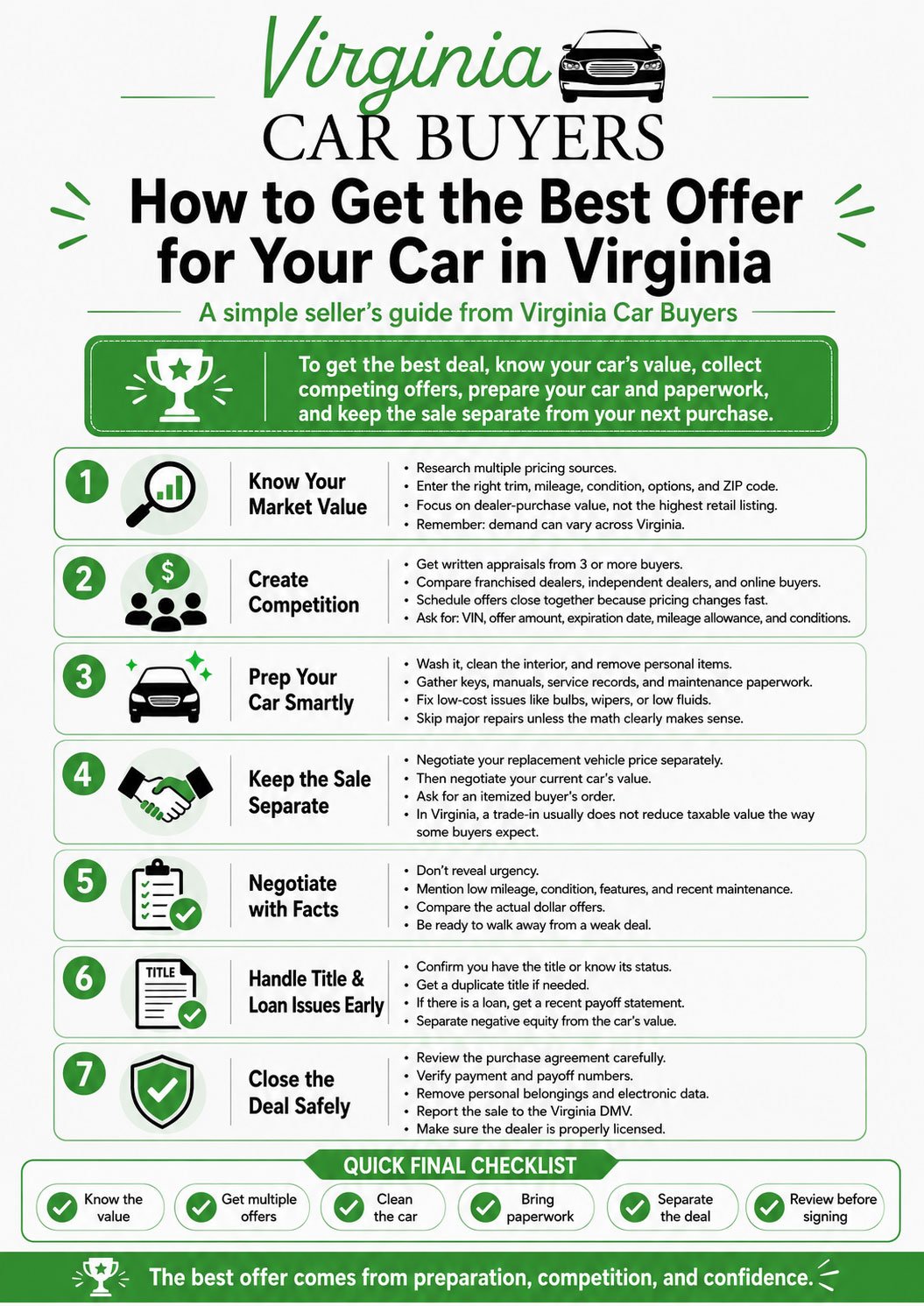
Establish Your Car’s Realistic Market Value
Do some research before you get in touch with the dealership about how much your car is worth. Don’t rely on just one source for the valuation. Use several available sources with a proper entry of the model, trim, mileage, drivetrain, vehicle options, condition, accident history, and your area’s ZIP code. Also keep in mind that demand may vary from one area to another. For instance, a four-wheel drive SUV may sell better in western Virginia, while a fuel-efficient commuting car may have a better market in a different geographic area, such as Northern Virginia, Richmond, or Hampton Roads.
Distinguish among three different figures:
- Retail value refers to the amount that a dealership may advertise for the car after refurbishing, cleaning, an oil change, tire replacement, and vehicle fluid checks.
- Private-party value is the amount that a buyer may pay.
- Dealer purchase or trade-in value refers to what the dealer can afford to pay for the car, and as a result, the amount is lower than that of a private party sale because the dealer has resale costs to pay.
Your reasonable target is generally around the competitive dealer-purchase range—not the highest retail listing you find online. Advertised prices also do not reveal what vehicles ultimately sell for.
Create Competition Among Dealers
The best negotiating tool is a legitimate written offer from a competitor. Contact three or more sources for car appraisals, and try to do this as soon as possible. A good idea is to contact franchised dealers of the vehicle brand, independent Virginia auto dealers, online car-buying companies, and large used-car dealerships in your area.
Depending on the kind of dealership looking at your vehicle, you could receive a much higher offer than its auction value. Let’s say you have a Toyota. A Toyota dealership may be willing to pay you more for your car than a luxury dealer whose customers rarely need a Toyota.
Book the dates of your appraisals one right after the other because market conditions can change, and so can used car pricing and dealership inventory. Ask the dealerships to send you an offer that contains the vehicle identification number, the amount they are willing to offer you, the expiration date, allowed mileage, and any conditions of the offer. Edmunds suggests that you also get an independent appraisal of your car so you can compare it with the offer you receive from the dealer where you might buy your next vehicle.
Prepare the Car Strategically
While presentation influences the mind of an appraiser, costly reconditioning does not lead to an equivalent increase in value. Clean the exterior of the car, sweep out the interior, get rid of personal items, remove any bad smells from the vehicle, and collect all keys, manuals, maintenance records, and other removable items.
The first step is to fix some easy-to-solve problems like blown bulbs, low fluid levels, warning lights brought about by minor maintenance issues, or very worn-out windshield wipers. The next step is not to spend your money on paint jobs, major mechanical repairs, and tires without calculating the repair costs versus the anticipated increase in the resale price. Often, dealerships repair the vehicle using cheaper wholesale or internal labor costs.
It is important to carry maintenance paperwork, particularly for extensive servicing done on the vehicle, whether it is for new tires installed, brakes installed, batteries replaced, or recommended work specified by the manufacturer. Any paperwork you have does not necessarily allow you to collect the exact amount you paid for the service, but it does lower the perceived risk factor for the buyer.
Be consistent in providing accurate information about accidents, problems with the vehicle, and dashboard alerts. Car dealers may check vehicle-history reports, inspection results, and available service records. Undisclosed problems may mean that the offer is lower or completely withdrawn.
Keep the Sale Separate From Your Next Purchase
Rather than negotiating the two transactions as one, agree upon the price of the new or used vehicle that you are purchasing. In the second step, negotiate the value of your vehicle. In the final step, negotiate financing and other optional products.
Dealerships can describe a deal in terms of one monthly payment, which can make it hard to evaluate if you are getting a good price on the car, the trade-in value, or the interest rate. Always ask for an itemized buyer’s order, where you find the actual figures that let you tally the transaction.
It is important to look at taxation policies in Virginia. The Sales and Use Tax on motor vehicle purchases in the state currently stands at 4.15% of the purchase price, or $75 at a minimum. According to the Virginia Department of Motor Vehicles, trade-in credits are part of the taxable gross sales price. This means that whereas in some other states trade-ins give a buyer the advantage of paying the tax only on the price of the new vehicle, in Virginia car owners do not benefit from trading in their vehicle when making a new vehicle purchase.
Consequently, you are generally able to contrast proposals at their intrinsic value. A car dealership presenting a trade-in figure of $1,500 lower than another dealership does not mean that it has to win just because it also sells the replacement car to you.
Negotiate the Appraisal, Not Your Personal Circumstances
You shouldn’t mention if it is urgent for you to sell. Let them know that you are getting a few appraisals and will make the sale to the one with the best credentials.
Focus on facts and avoid being overly emotional about the transaction. Mention information from recent successful maintenance of the equipment, its condition, any advanced features, and low mileage. Be prepared to leave the negotiations. A credible readiness to leave a negotiation counts more than prolonged bargaining.
Resolve Title and Loan Issues in Advance
Make sure that you either have the Virginia title or know whether it exists in an electronic format. If you have misplaced the title, please get a replacement title before you finalize the sale, if needed. Virginia DMV has a $15 fee for replacement titles, but there are certain exceptions.
If the vehicle has an active loan, make sure you get a recent payoff statement and ask the dealer about the method of payment to the lender. If the offer exceeds the payoff amount, the dealership has to pay you the difference. If the payoff amount is higher than the offer, you have to pay the negative equity yourself. Negative equity should not be included in the value of the car, as it is a separate debt.
When closing, truly examine the purchase agreement, ensure that the payment amounts as well as the payoff amount are accurate, eliminate personal belongings and electronic data from accounts, and make sure to keep a record of all the documents signed as well. Owners of vehicles in Virginia must report the sale of their vehicle to the DMV after they sell or trade it.

Last but not least, make sure the Virginia dealership you are dealing with has valid licenses with the Dealer Board. The board provides a dealer search tool and helps with complaints associated with Virginia dealers.
The best dealership deal is seldom a great negotiating phrase. Such a deal is made from accurately assessed value, numerous time-sensitive bids, tidy and organized paperwork, proper separation of the sale from any acquisition of a replacement, and the ability to turn down a bad deal.