Selling a scrap car in Virginia looks easy, just contact a junkyard, receive their quote, and get the vehicle removed. In reality, you can miss out on money simply by accepting the first quote.
In order to maximize your payout, you should be aware of the way junkyards do their job to be able to compare different offers correctly, complete all necessary documents in advance, and avoid hidden fees that show up only when the truck arrives.

Here are some pro tips on how to maximize the amount of money a local scrapyard will pay you for your vehicle:
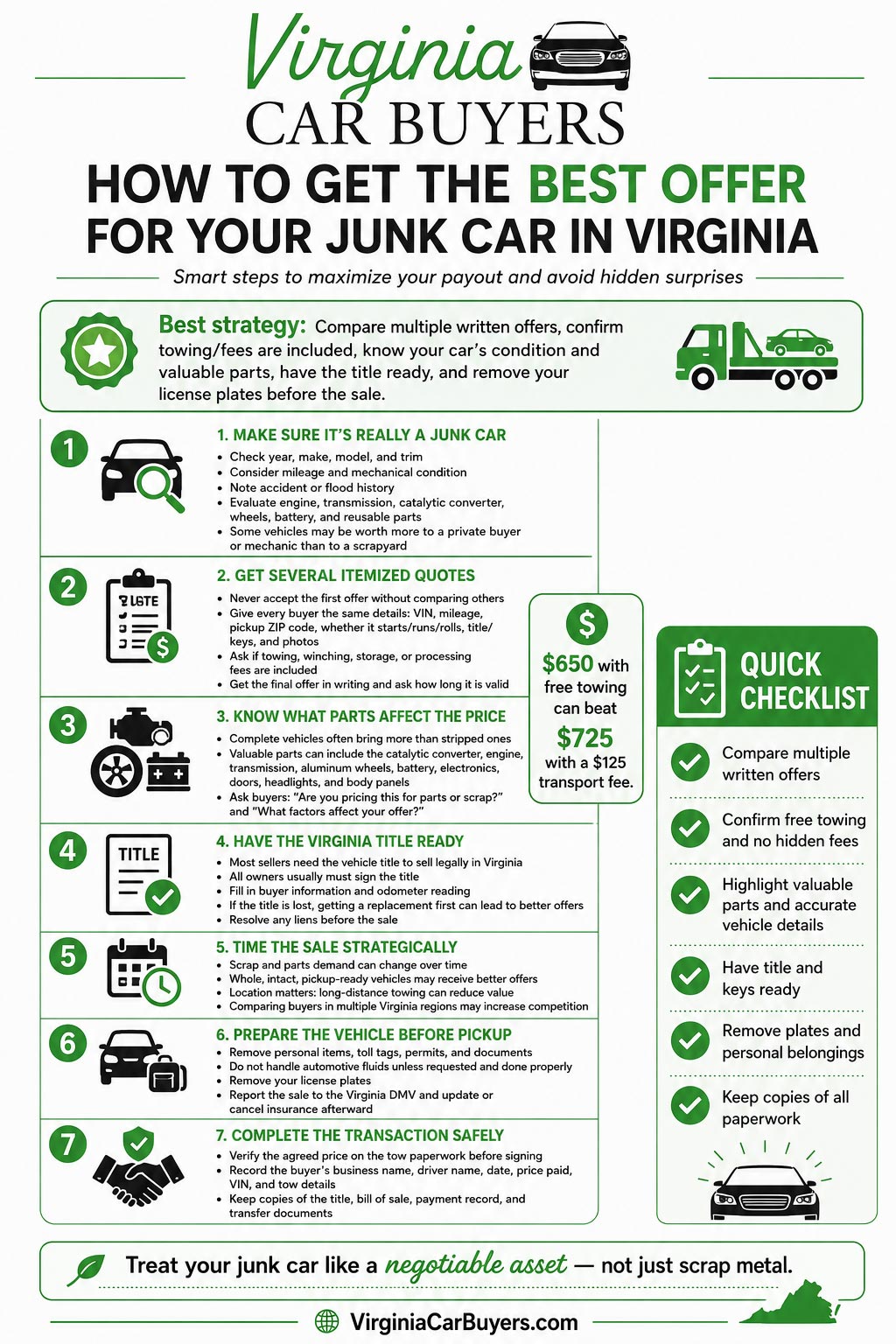
If you want to receive the maximum payment for your old car in a Virginia junkyard, consider comparing multiple offers received in writing and confirm that they include fees and delivery costs. Make sure to have the car information, such as its condition and valuable parts, with you. Additionally, be sure to have the title of the vehicle and remove your license plates prior to making the sale so that issues are avoided when processing the paperwork.
Quick Visual Aid for Getting the Most Money Selling a Car to a Virginia Junkyard
Determine Whether the Car Is Truly a Junk Vehicle
Make sure that scrapping is indeed the best option prior to obtaining quotes from scrap yards. In cases where the vehicle is still functional and has a good brand or important parts that can be reused, the vehicle may be worth more to a private buyer or mechanic than to a junkyard.
Consider the car’s:
- Year, make, model, and trim
- Mileage and mechanical condition
- Accident and flood history
- Engine and transmission condition
- Catalytic converter, wheels, battery, and other major components
- Local demand for used parts
Usually, junkyards determine the value of cars by using the amount of scrap metal in the vehicle in addition to the demand for auto parts that can be reused. For example, a complete vehicle from a make such as Honda, Toyota, Ford, Jeep, or any other well-known brand may receive a higher price since the junkyard can sell some of the components again. On the other hand, if a certain make of car is less popular, the junkyard may assign it a value based on its weight.
Request Several Itemized Quotes
You should never take the first estimate that you are given. Always check with a few more licensed companies in Virginia, like auto recyclers or salvage dealers, so you can compare them with the first offer.
Give every buyer identical information:
- Vehicle identification number, or VIN
- Exact mileage
- Zip code and pickup location
- Whether the car starts, runs, rolls, steers, and brakes
- Condition of the engine and transmission
- Whether all wheels, tires, catalytic converters, and major body panels are present
- Whether you have the title and keys
- Photos showing the vehicle’s condition
Ask if the quoted amount is the total amount you receive after costs incurred for towing or any other type of fee. Some buyers may entice you with their price offer only to add afterward the fee for towing, winching, storage, processing, or missing parts. Get the final offer in writing either via email or text and ask until when it is valid.
Don’t look just at the headline numbers. An offer of $650 with free towing is better than an offer of $725 with $125 for transport.
Understand Which Parts Affect the Offer
In general, the complete vehicle may be more valuable to a junkyard than a vehicle that is picked apart for parts. The catalytic converter has an important role in that it contains metals that can be recovered, and it may also be a requirement for the buyer to confirm the completeness of the vehicle. There are also other factors affecting the value of the vehicle, such as engine and transmission, aluminum wheels, batteries, electronic modules, doors, headlights, and working body parts.
While it is possible to get more total revenue by selling parts one by one, you should only do so if you really know the market and have enough time, tools, sufficient storage space, and the legal right to take apart the vehicle. Parting out the vehicle before you contact junkyards might result in their offer being less than the amount of money you get by selling parts.
When talking to the buyers, you should ask 2 questions: “Are you evaluating this vehicle for parts or just for scrap purposes?” and “What are the elements that contribute to your offer?” The answers help determine whether other types of buyers will be able to offer more.
Have the Virginia Title Ready
Correct paperwork helps ensure that your negotiation results are successful and that the buyer is less likely to reject the car. In Virginia, a person selling a car is usually required to legally possess the vehicle’s certificate of title. A person may not sell a vehicle without legally possessing the title unless he or she has gone through the required legal process.
In order to transfer a vehicle titled in Virginia, all owners must sign the seller section of the title document. It’s also necessary to fill in the buyer’s information and current odometer reading.
If you have lost your title, applying for a replacement prior to selling your vehicle could lead to better deals and more genuine buyers. Be wary of junkyards that claim they can purchase any vehicle without a title. Although there are very limited methods in Virginia that deal with specific cases of abandonment and demolition, that does not exempt the regular owner from having to prove ownership of the car.
It is also important to check for any existing lienholder against the vehicle. A buyer may decline the vehicle until the lien is released since it is not possible to pass on the clear title by simply handing over the vehicle.
Time the Sale Strategically
The scrap metal industry works differently, and each junkyard has its own requirements concerning the scrap that they buy. Therefore, the market price can vary from one year to another, depending on a particular buyer, their location, and the type of metal they are interested in buying. You should find out whether the price is dictated by the demand for metals or by a need for a particular part of your vehicle. If your car is whole, intact, and ready for pickup, say this to the junkyard.
The location is also important. A rural pickup that requires a long-distance tow may be worth less than a car located near Richmond, Hampton Roads, Northern Virginia, Roanoke, or any other area that has multiple potential recyclers. Routing your search farther afield could lead to more competition, provided you still verify that the long-distance towing will be free.
Protect the Vehicle Before Pickup
You may take out any personal property, toll transponders, parking permits, insurance identification, garage-door openers and other documents. You do not have to remove gas, oil, antifreeze, refrigerant or other fluids unless the buyer requests it or you are equipped to handle them properly. According to Virginia DEQ, automotive fluids contain harmful chemicals and must be handled or recycled properly.
Be sure to take off your license plates before letting go of your car. Once you sell your car or take it for junking, make sure to report the transaction to the Virginia DMV and take care of the plates. The Virginia DMV has an online report option if you sell your car, and plates may be transferred, turned in, or inactivated. Once you complete the transfer of your vehicle, make sure to get in touch with an insurance company and have your insurance canceled or updated accordingly after the plates are transferred, turned in, or inactivated.
Complete the Transaction Safely
At the time of the towing operation, make sure to verify the tow operator’s document with the arranged price. If there are any blank spaces or an incorrect price on the paper, do not agree to sign it. Write down the buyer’s business name, the driver’s name, date, price paid, VIN, and tow instructions. Keep copies of the title document after signing, the bill of sale, the payment note, and any document showing that the buyer takes the vehicle.
The strategy behind this is very easy: document the car properly, save valuable parts of the car, gather competing net offers, and fulfill the Virginia ownership requirements. The sellers that see their junk cars as negotiable assets and not just useless metal usually get the most money from them.